

What is a trucker’s hitch knot and how to do one


Table of Contents
A fundamental part of an HGV driver’s job is to secure the load they need to transport.
But if you found yourself without ratchet straps or chains and binders, would you know how to competently secure a load with just a length of rope?
The trucking experts at HGV Training Network reveal all you need to know about a trucker’s hitch knot and how to tie one!

What is a trucker’s hitch knot?
Used to secure loads on trucks and trailers, a trucker’s hitch knot was primarily used by older generations of HGV drivers.
Favoured because it creates high tension on ropes or straps, it can easily, quickly, and securely strap loads, making it a great go-to option if you find yourself with no alternative.
The knot is also known by many other names, including:
- Lorry knot
- Power cinch knot
- Wagoner’s hitch
- Dolly knot
*If you aren’t yet out driving HGVs but would like to, HGV Training Network can help you with a full range of LGV/HGV training courses. Contact the team to get started!

Pros and cons of a trucker’s hitch knot
- It can be pulled incredibly tightly
Thanks to the pulley system it creates, the trucker’s hitch knot multiplies the force applied, allowing the rope to be pulled much tighter than an HGV driver could by hand – thereby making it more secure.
- Increased safety
Unlike ratchet straps, which feature mechanical parts that could fail or rust, a trucker’s hitch knot relies only on the condition of the rope.
- Quick-release mechanisms
If you need to unload in a hurry or in an emergency, this knot includes a quick-release feature that allows you to almost immediately relieve tension on the load when not needed.
- Jamming risk
If the knot is under heavy strain, it can jam – making it tricky to undo. This is especially true if it has become swollen from rain exposure.
*With thousands of driving jobs up for grabs and fast, trusted training that could see you qualified in as little as five days, register with HGV Training Network today!
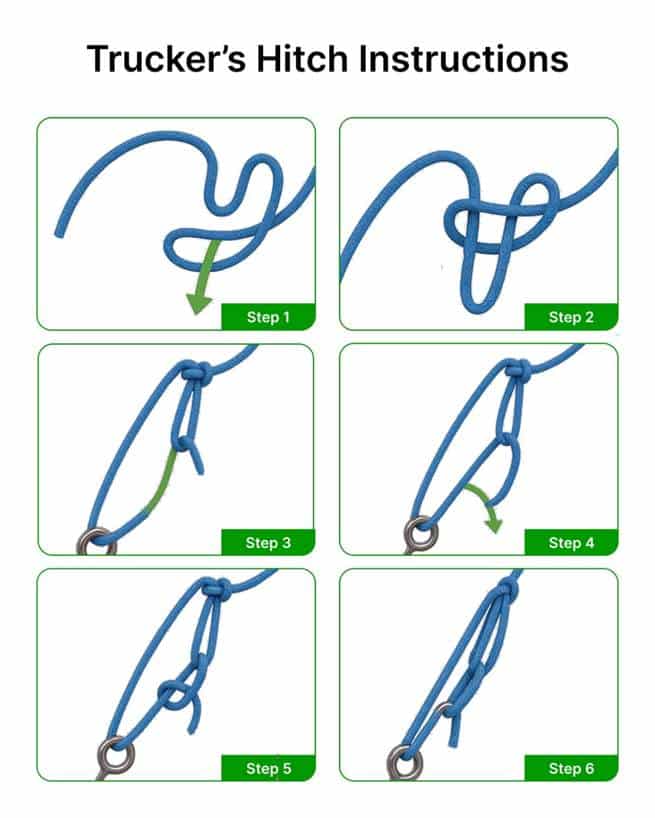
How to tie a trucker’s hitch knot
- Tie your rope to an anchor point – This could be a post, bumper, or hook – whatever you have to hand. This is your anchored end. The free end (loose end) is what will form the tensioning system once tied.
- Create a loop in the rope about halfway between the anchored and free ends – To create the loop, twist the rope so one side crosses over the other. Then, hold this crossover point with your fingers – this will act as the pulley in your tensioning system.
- Feed the free end through – Pull enough so you have some slack to work with, but not too much.
- Tighten the loop to form the pulley – Pull the section of rope that leads back to the anchored end while keeping some tension in the free end. This will lock the loop and create the pulley mechanism for easy tightening.
- Secure the free end to a second anchor point – Be sure to use the free end and choose another secure anchor point – it could be the load you are securing.
- Tighten the rope and secure the knot – Using the pulley system you’ve just created, pull the free end back toward yourself. As the rope runs through the loop, your pulling force will be multiplied – removing slack and achieving a tight hold between two anchor points. Using two half hitches around the main lines of the rope – the sections running between the anchors. This will lock everything in place. How to tie a half hitch: Wrap the free end around both rope strands, make a small loop, pass the free end through, and secure tightly. Do this once more to double-lock it.
- Double-check the knot – Give the rope a firm tug or two to ensure everything is secure – it should hold strong under tension, with no slack, while still being easy to untie when it’s time to deliver your load.
Make campervan trips a reality with HGV Training Network
Whether you choose to utilise a trucker’s hitch knot every day or simply stay familiar with it in case of emergencies, an awareness of the methods of the past could stand you in good stead.
For this knowledge – and much more recent insights – come to HGV Training Network for your initial or periodic HGV training.
With trusted instructors who have decades of on-the-road experience, we can help you pass your tests and become an excellent driver.
To find out more, email us at contact@hgvtrainingnetwork.com or fill in the contact form below and we’ll arrange your bespoke training package.